Born to Run

Right before my surgery, I was scrolling Instagram, as one does to pass the hours when sidelined with injury. By that point my feed was full of foot and ankle physiotherapists and influencers, the algorithm clearly tapping into my endless Google requests to understand what happens when you have a bunch of foot and ankle procedures done all at once. And then I was stopped cold by a 27-year-old Tanzanian runner named Mayko Geay, with a personal best of 1:03 in the half-marathon. Do the math and that comes out to a sub-5-minute mile, which, for a young male elite distance runner, is good but not remarkable. What you may not know is that Mayko has a stride one might consider to be… ahem, unique.
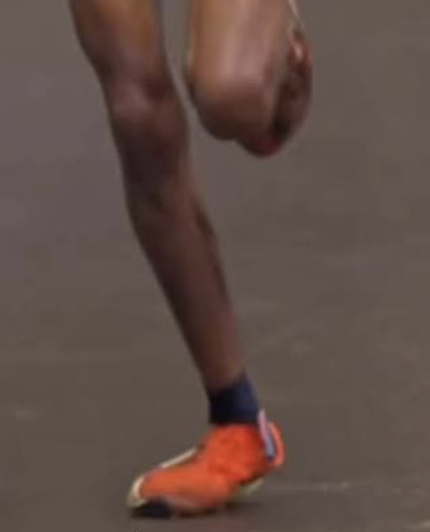
That photo is his foot hitting the ground and propelling forward at a pace of under 5 minutes per mile. I tried to find more videos, but this IG reel does a great job of showing just how much he pronates. That pronation is his posterior tibial tendon doing all the work — that is, the one I’ve now had removed from both of my feet. I watched the video multiple times in an attempt to grasp how on earth he can run like that and not blow out both of his feet.
And then I asked ChatGPT how he can do this, and the answer was incredibly telling:
As Tanzanian marathoner Mayko Geay runs, his ankles collapse inward so violently it looks like an instant injury. Traditional running wisdom says this level of overpronation should tear his lower leg apart. Yet, he runs a 64-minute half marathon completely pain-free. How is this physically possible? It comes down to a perfect storm of hidden strength, rapid physics, and modern tech.
- Immense hip and glute strength: While his ankles cave in, his knees stay perfectly aligned and never roll inward. His hips and glutes act like massive anchors, twisting outward to stop the rotation from traveling up his leg. This isolates the stress and saves his joints.
- The “rubber band” effect: Geay doesn’t heavy-handedly sink into his arches. His foot touches the ground for only a split second. He uses the inward collapse like a loaded spring, storing elastic energy and snapping his foot off the ground before his tendons hit their breaking point.
- Tough, adapted tendons: Years of high-mileage training have physically changed his body. His posterior tibial tendon and plantar fascia have likely grown thicker and denser over time, adapting to the extreme tension like a heavily conditioned muscle.
- Lucky genetic anatomy: Elite athletes are built differently. Geay likely has unique bone alignment in his shins and hips, alongside naturally flexible midfoot joints. This allows his skeleton to safely absorb a range of motion that would break an average runner.
- Super-shoe protection: As an ASICS-sponsored athlete, Geay trains and races in cutting-edge “super shoes.” The thick, high-tech foam absorbs the hardest impacts, while the stiff internal carbon-fiber plate acts as a track, forcing his foot forward even when his ankle collapses sideways.
Obviously I can’t take advantage of the last two bullets. But the first three? Those are trainable, and they’re now the blueprint.
First up: hip and glute strength. Rebuilding my posterior chain is a key component of my upcoming “return to heavy-ass lifting.” Many runners, especially those of us who sit at desks all day, have incredibly weak posterior chains. When I started heavy lifting last year, I was amazed at how much faster I became in the really long distances like 100 miles. Just one session a week of 300-pound leg presses to complete failure turned on something back there that kept fatigue at bay after a few hours and let me run my fastest 100-miler times ever.
Next, if I expect to run well again: a return to the POSE method. Years ago I worked with a POSE running coach who transformed how I ran in a matter of weeks. As a result, I qualified for Boston two more times, both faster than my previous marathon times. The one requirement with Coach Tracy was moving away from maximal, thick, plush shoes to zero-drop Altras. I’m not sure if I can do those again, but I think it’s worth a try.
Finally: strong, trained tendons. Dr. Stein told me this is it for both feet. I blow out these new tendons and there are no more spares. I promised myself when I got through this, I’d take much better care of my ankles going forward. No excuses, no “maybe tomorrow”s.
I’m excited to see what I can do. Of course I’m not going for a sub-5-minute mile. But if a guy whose ankles fold in half can run a 64-minute half marathon, then a woman with two factory-refurbished feet, a leg press habit, and exactly zero spare tendons can surely find her way back to mile 100. Genetics deals the cards; training plays the hand. Mine’s holding a pair of brand-new tendons and a well-built posterior chain — and I’m going all in.