Easy

Day 5. Time for a check-in.
But first, a reminder of why this journal exists at all. Yes, it’s an outlet for me to process everything I’m going through. But the bigger point is to show what a major orthopedic surgery actually looks like for someone who can’t go a single day without being highly active. Distance runners, and especially ultrarunners, operate on the assumption that we have no bounds except the self-inflicted ones. That’s true right up until it isn’t. None of us plan on an injury, and most of us prefer to ignore one when it shows up, hoping it will magically heal on its own. Then comes the day we realize we HAVE to have the big scary procedure, and we are, as a species, terrible at leaning into the recovery. So this blog is the map I wish I’d had: here’s what it looks like, here’s what to expect, here’s what helps.
So, the day-5 report: this time around has been much kinder. I honestly can’t tell you why there’s been less pain overall, considering I had two additional procedures this round. My best guess is the pain management approach. The first time, there was no extended-release OxyContin; the plan leaned on a continuous peripheral nerve block for the first 24-36 hours, a physical pump doing its thing around the clock. That is, until it ran out. Ooof, that was a hell of a cliff dive, deep into the pain cave. This time it was five full days of Oxy ER, and if I had to do it over, I’d pick the Oxy ER over the pump without hesitation.
The secondary pain management approach mattered too. With doctor approval, I took up to four Advil a day for the first three days, proactively, before the pain ever hit. For the last two days I’ve been on Tylenol only, because nothing has really climbed above a 2 or 3 on the pain scale. The goal was to never get above a 5 or 6, and that’s happened exactly once: in the middle of the night a couple nights ago, when I woke up and found my leg had slid off the bolster and was lying flat on the couch. I popped an Advil, repositioned the leg even higher (think nearly 90 degrees, straight up), the throbbing eased, and I fell back asleep. The rule is simple: foot and ankle higher than my heart, always, literally as high as I can possibly get it.
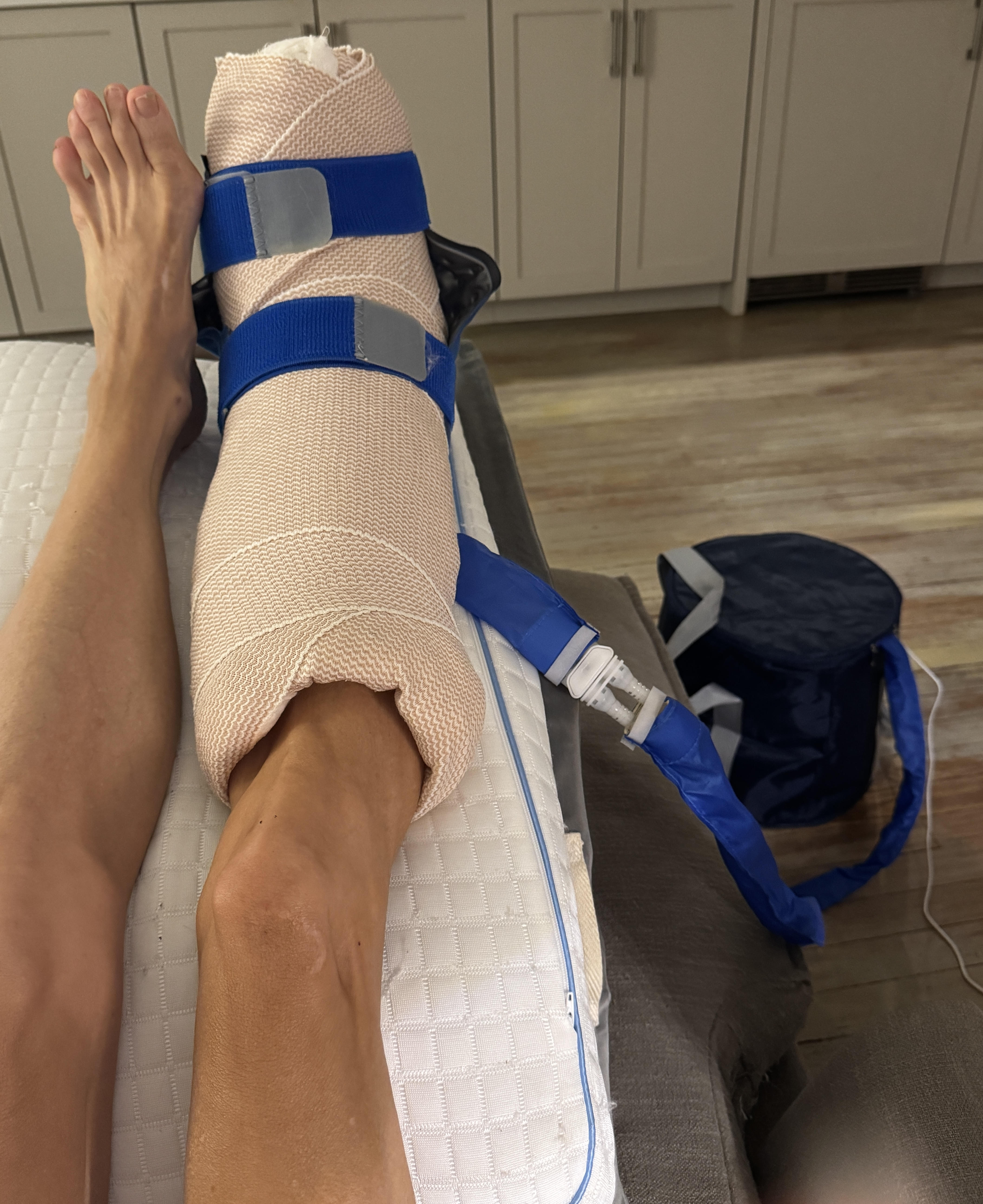 And then there’s the other full-time resident of my recovery setup: the continuous icing machine. I picked this thing up from Amazon ($90, extremely well spent) and its whole job is to pump ice water from a big cooler through two hoses into a dry pad that wraps around my foot. Because of its shape, it straps to just about anything. It runs for 30 minutes, then I hit the button and go another 30. Absolute perfection. I can’t love this thing enough.
Finally: sleep is the priority. Everything about these five days has been exhausting, so I’ve slept. Eight to nine hours a night, another hour or two during the day. My body is trying to literally regrow and repair shit; it needs rest and nutrition (more on the nutrition later). I even bought PainQuil PM by Vicks, which is exactly what it sounds like: pain medication (acetaminophen) plus sleep meds (diphenhydramine). It knocks me out well enough to buy at least a few solid hours before the first wake-up.
Five days down, and here’s the takeaway for any runner staring down their own big scary procedure: recovery is an endurance event too. You can’t sprint it, you can’t skip it, and you definitely can’t ignore it into not existing. What you can do is control the controllables: ice always running, foot always up, meds on schedule, sleep treated like training. Do that, and day 5 might just surprise you. Mine did. Easy like Sunday morning.
- Five days in and pain has mostly held at a 2 or 3, despite two additional procedures this time
- Down to Tylenol only for the last two days; the Advil earned its retirement
- Sleep like it's my job: 8-9 hours a night plus a daily nap while the body does the rebuild
Advil, up to 4 a day for the first 3 days, taken proactively before the pain hit (with doctor approval).
Tylenol only for days 4-5, since nothing has crept above a 2 or 3.
PainQuil PM at night: acetaminophen plus diphenhydramine, exactly what it sounds like.