Stronger

Fair warning: this one’s going to be controversial. Today is reconstitution day for my recovery peptides, and for anyone who isn’t up to speed on grey-market injectables, here’s a short primer before I get into what I’m actually doing.
What are peptides?
Peptides are just short chains of amino acids, the same building blocks that make up proteins.
- 2–50 amino acids = a peptide
- 50+ amino acids = generally considered a protein
If proteins are full books, peptides are chapters. Your body already makes thousands of them, and they act as chemical messengers: they tell cells what to do. They don’t do the work themselves, they just hand out instructions. Things like:
- “Repair this damaged tissue.”
- “Reduce inflammation.”
- “Make more insulin.”
- “Digest this food.”
As a diabetic on a low-dose GLP-1 (which is itself a peptide), I’m more open than most to using others, mainly because GLP-1s are genuine miracle drugs. This is the part where people get weird about it. Outside of a few exceptions like insulin (yes, insulin is a peptide; in fact it was the very first one ever discovered, more than 100 years ago), peptides are not FDA-approved. That makes them harder to procure, and it means the research is limited and usually anecdotal. A real your-mileage-may-vary situation.
So people like me buy them on the grey market, from vendors we trust who provide a certificate of analysis (COA) for each vial. They arrive as a powder. I reconstitute them with BAC, or bacteriostatic water, draw them up, and inject. Then they go to work over time.
Keep in mind: this is something I’ve spent a lot of time researching and have decided on for myself. I am not a doctor, and I can’t explicitly recommend any of it. But I’m documenting my recovery honestly, and that includes three key players.
The three I’m running
- BPC-157 (Body Protection Compound-157): a synthetic peptide derived from a protective protein found in the stomach. Studied for its potential to promote tendon, ligament, muscle, and gut healing.
- TB-500 (Thymosin Beta-4 Fragment): a synthetic version of part of the naturally occurring protein thymosin beta-4, which plays a role in tissue repair and cell movement. Common in research and among athletes hoping to speed recovery.
- GHK-Cu (Glycyl-L-histidyl-L-lysine Copper): a naturally occurring copper-binding peptide found in human plasma, saliva, and urine that declines with age. It has the strongest evidence of the three for skin regeneration and wound healing, and is also being investigated for hair growth, anti-inflammatory effects, and tissue repair.
Enter Wolverine
The first two can be combined into a blend known as “Wolverine.” A silly name for a powerful little pepper. I usually run them separately, but for ease of use in the first few days I picked up the pre-made blend, a 50/50 of each, and I’ll switch back to dosing them individually once the numbers shift.
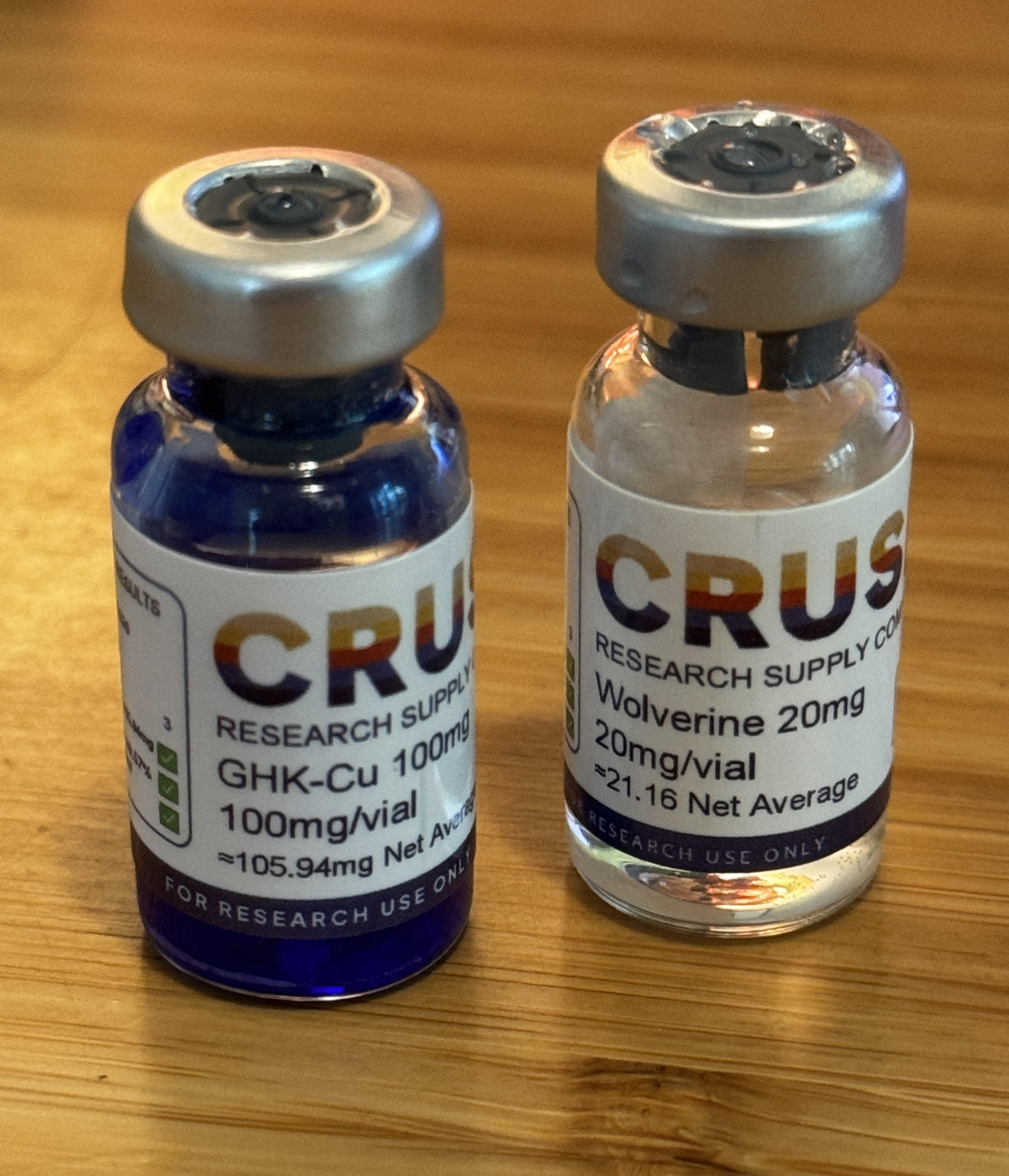
Here’s the schedule. Starting the day after surgery, I inject daily: Wolverine in the morning, then Wolverine and GHK-Cu together in the evening. Wolverine gets two shots a day because its half-life is measured in hours, not days, so a 12-hour cycle keeps more of it in my system, more evenly, instead of letting it spike and crash.
I don’t have an adamantium skeleton or a mutant healing factor, so this is me outsourcing the job, one subcutaneous milligram at a time. The claws are metaphorical, the needles are not. I’ll report back on whether the foot agrees with the experiment. Snikt.
- Reconstitution day: vials mixed, dosing schedule mapped out before surgery
- A healing stack I've researched for months, finally ready to go
- Three days until the rebuild, and the toolkit is stocked
GHK-Cu: 1x/day in the evening.
All reconstituted from powder with bacteriostatic (BAC) water, then injected subcutaneously.